2014-05-22

逮捕されました。


2013-10-23

VOA - Bad Taste in My Mouth


Script from the October 23, 2013 14:29 UTC episode of English in a Minute (EIM) by Voice of America. (Link: http://learningenglish.voanews.com/media/video/1670596.html)

Host: Welcome to English in a Minute, where we teach you all about idioms in American English. There are times when something occurs and you might say, "This left a bad taste in my mouth." What does this phrase mean?

Woman: "A bad taste in my mouth."


Dialog:

Man: Hey, how was your vacation?
Woman: It was great! But we had all of the money stolen from our hotel room.
Man: Oh, I am sorry to hear that.
Woman: I know, the whole thing left a really bad taste in my mouth.


Host: If something leaves you with a bad taste in your mouth, you feel there is something wrong about the situation. It gives you an unpleasant feeling or memory. Of course, you can also eat something that literally leaves a bad taste in your mouth. Either way, if something leaves a bad taste in your mouth, it isn't good. And that's English in a Minute!


Disclaimer: "Voice of America", "VOA", the VOA design, and "voanews.com" are trademarks of The Voice of America ("VOA").

No Endorsement: This blog may contain links to other sites. These links are provided as references to help you identify and locate other Internet resources that may be of interest. These other sites were independently developed by parties other than ANMI English Tips and Tools, and ANMI English Tips and Tools does not assume responsibility for the accuracy or appropriateness of the information contained at such sites. In providing links to other sites, ANMI English Tips and Tools is in no way acting as a publisher or disseminator of the material contained on those other sites and does not seek to control the content of, or maintain any type of editorial control over, such sites.

A link to another site should not be construed to mean that ANMI English Tips and Tools is affiliated or associated with, or is legally authorized to use any trademark, trade name, logo or copyrighted symbol that may be reflected in the link or the description of the link to such other sites, except as specifically stated.


Key Phrases (English & Japanese):
  1. a bad taste in one's mouth: 口内の味が悪くなる (literal)
  2. a bad taste in one's mouth: 印象を与える (idomatic)
  3. stolen:  盗まれた;stealの過去分詞形
  4. sorry to hear that: それはお気の毒に
  5. I know; I know what you mean: その通りです。


Another Sample Dialog:

A: Hey, how was your weekend?
B: Well, Saturday was OK. But, my soccer match got rained out on Sunday.
A: Oh, I'm sorry to hear that.
B: I know. The weather left a bad taste in my mouth.


2013-02-19

Black Jelly Beans?

Black stones at the base of the water fountain where you wash your hands at a Japanese Shinto shrine.
--
black stones: 黒い丸い石
at the base of 〜: 〜の麓
water fountain: 噴水式水飲み場
where you wash your hands: 手を清める場所
Shinto shrine: (神道の)神社


2012-12-28

Chip's Adventure (Chiventures)


この会話は先生と中学性の3年生の英会話です。

Aさんが生徒、Bさんが先生


A:What day is it today?
B:Today is the first day of the rest of your life.

A:I'm sorry. I meant to ask, "What is the date today?"
B: Oh, I see. Today is Friday, December 28th -- only three more days left in this year!

A:Got it. Thanks. So, how was your day today.
B: It got off to a great start. I took my dog, Dale, running with me this morning. I think we covered about four and a half kilometers within about 30 minutes. Our pace was a bit slow, but it's better than nothing.

A:Isn't your real name also Dale?
B: Yes, it is. But, I don't use that name with most Japanese. So, I gave her my name. She's very lucky!

A:What a touching story! It must be fun to have a "real" Chip and Dale running around the neighborhood.
B:That's right!

A:Well, it's time to head back. Hope you have a nice day, a nice weekend, and a very happy New Year's holiday.
B: Thanks! You, too!

2012-12-26

Christmas and New Year's Holidays


この会話は先生と専門学校の2年生の英会話です。

Aさんが先生、Bさんが生徒


A: How are you today?
B: I’m fine. > I’m doing pretty good.

A: How was your Christmas?
B: It was good. > It was pretty nice.

A: What did you get for Christmas this year?
B: I got a DVD box set [a DVD boxed set] from my mom.

A: What TV series or movie series was it?
B: It was a boxed set of the American TV series called “Bones.”

A: Did you get anything for your mom or dad?
B: No, I didn’t. But, I usually give my mom or dad something for their birthdays.

A: What are your plans for the New Year’s holidays?
B: I haven’t made any plans yet.

Notes:

1. 「pretty」は「可愛い」と言う意味ではなくて、「綺麗な」又「かなり」と言う意味です。
2a. 「get something for when」は「何かを貰う」の意味です。
2b. 「get something for someone」は「何かをあげる」の意味です。

2012-12-25

Class Notes - Christmas and New Year's

この会話は先生と小学校5年生と中学校3年生の英会話です。

Aさんが先生、Bさんが妹、Cさんがお兄さん

A: How was your Christmas?
B&C: It was great! / It was good. / It was nice. / It was so-so. / It wasn’t so good. / It was awful.
意味:最高! / 良かった / とても良かった / まぁまぁ / あんまり良くなかった / 最悪.

A: What did you do?
B: I made a layered sponge cake with whipped cream and strawberries.
C: I helped my sister with the cake by whipping up the cream.

A: Did you exchange Christmas gifts with anyone?
B: Well, I got some Christmas presents. I didn’t give anyone any presents this year.
C: No, I didn’t. In fact, I didn’t get any presents.

A: What did you get for Christmas? / What would you like for Christmas?
B: I got an iPod Nano.
C: I would like a new smartphone.

A: Are you looking forward to the New Year’s holidays?
B: Yes, I am. I want to enjoy some soba.
C: No, I’m not. I have to study very hard.

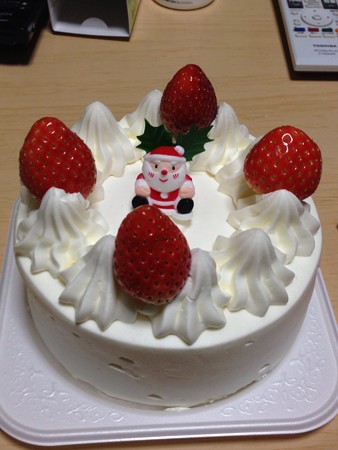
1223今年のケーキ

2012-12-22

Strawberry Shortcake

Why is strawberry shortcake called a "shortcake"?

Some students thought that "shortcake" means a short, small piece of cake. Of course, many different kinds of cake are sold at Japanese bakeries as single pieces of cake. But we don't call all of those kinds of cakes "shortcake."

According to Barron's Food Lover's Companion (Food Lover's Companion. Copyright © 2001 by Barron's Educational Series, Inc.), a shortcake "is a large, sweet biscuit that is split in half, then filled and topped with sliced or chopped fruit (traditionally strawberries) and softly whipped cream."

Shortcake is called "shortcake" because it uses a "shortened dough" just like the dough used to make biscuits. Normal cake batter is like a liquid and is poured into a pan before baking. Shortcake dough is formed and cut before placing on a cookie sheet for baking.

What is "shortened dough"? First, there are two types of dough: shortened dough and long dough. Both types of dough use shortening, but the technique of mixing the shortening into the dough is different. Long dough is used for pie crusts. Short dough is used for biscuits and tarts.

Thus, the name of "shortcake" comes from the use of "short dough" or "shortened dough."

In Japan, I have never seen a real strawberry shortcake. The so-called strawberry shortcake sold all over Japan is really a layered sponge cake with strawberries and whipped cream.

So, if you have a chance to try real strawberry shortcake overseas, please give it a try! Until then, I hope you enjoy your sponge cake during the Christmas holidays here in Japan!


2012-12-21

Christmas Dinner

What will you have for dinner on Christmas Eve or Christmas Day? Where turkey is the traditional standard on Thanksgiving Day in the States, glazed ham is the traditional standard for Christmas dinner.

When I was a kid back in the States, I remember my mom serving honey glazed ham that had been roasted in the oven, carrot pineapple Jello salad with whipped cream, freshly baked rolls, deviled eggs, pickles, olives, and various cakes, pies, and/or Christmas cookies.

Some of the students have told me what they will have for Christmas dinner this year. The offerings are quite different from what I used to have back home.

"We will have sushi, fried chicken, and strawberry shortcake."

"My mom will serve roast chicken."

"We will have the same dinner as usual: rice, miso soup, pickled side dishes, and some small Salisbury steaks."

Of course, many students wanted to say "Christmas cake," which is a kind of 和製英語. There is no such cake called "Christmas cake" in the States as far as I know. We do have Christmas cookies, however.

So, if you want to refer to クリスマスケーキ in English, I would suggest you simply say, "strawberry shortcake."


2012-12-19

Hyphen

Use hyphens for compound words:

例: a five-minute walk; a high-speed chase; the front-right seat; a never-seen-before magic trick; the blue-white train; a flow-type air micrometer; etc.

Use hyphens for numbers:

例: a thirty-three thousand dollar car; sixty-two billion dollars in tax cuts; eighty-four yen per dollar; two-tenths of a percentage point

Use hyphens with some prefixes:

例: anti-aging cream; extra-condensed; semi-independent; self-help therapy; half-baked idea

Note:

Be sure to check a dictionary for proper spelling. Some compound words have become single words. For example, the term "electronic mail" became "E-mail" with a hyphen. Then, "E-mail" became "e-mail" with a lowercase "E." Then, "e-mail" became "email" as one word.

References:

1. APS Style Manual (http://www.apsstylemanual.org/apsHouseStyle/punctuation/hyphens.htm)
2. The Mayfield Handbook of Technical & Scientific Writing at MIT (http://www.mit.edu/course/21/21.guide/hyphen.htm)
3. The Chicago Manual of Style, 15th Edition


2011-11-26

Skype Call Recorder, Riviera for Skype


Skype Call Recorder, Riviera for Skype looks like the kind of application that could have a lot of useful purposes for not only conducting our Skype-based lessons, but also for conducting Skype-based business calls. I have yet to try the software, but I see a lot of potential.


Creative Commons License
ANMI English Tips & Tools by
アンミ英会話教室 is licensed under a
Creative Commons Attribution-NonCommercial-ShareAlike 3.0 Unported License.

2011-07-14

A Moment of Silence

Highlights from Today's Class

When do you "pause for a moment of silence"?

I pause for a moment of silence during public commemorations of something sad. You can see people pausing for a moment of silence at Ground Zero in New York City. Many people in Japan and especially in the Tohoku region paused for a moment of silence on April 11th, May 11th, and June 11th.

I paused for a moment of silence when I visited the Nagasaki Peace Park many years ago. I also paused for a moment of silence when I visited the graves of my relatives.

See if you can catch the phrase, "paused for a moment of silence" in this CNN video:

Link:  http://edition.cnn.com/video/?/video/education/2011/05/11/sn.0512.cnn

- pause for a moment of silence
- 黙とうをささげる
- Mokutō o sasageru

Creative Commons License 
ANMI English Tips and Tools by Chip Sorensen 
is licensed under a Creative Commons Attribution-Share Alike 2.1 Japan License. 
Based on a work at anmienglishtools.blogspot.com.

アンミ英会話教室
234-0053神奈川県横浜市港南区日野中央2-6-3パークサイド日野102号
http://www.anmi-eikaiwa.com/ | support@anmi-eikaiwa.com 
Tel. 045-841-4218 | Fax 045-841-4288
携帯リンク http://www.anmiweb.com/mobile/

2011-03-18

English Messages to Overseas Coworkers and Colleagues

On the 16th, I posted messages for personal contacts. The following post is more oriented towards coworkers and colleagues:
Thank you for your concerns.
Thank you for your kind words.
Thank you for your prayers.
Thank you for your messages of concern.
We are doing fine.
We are doing OK.
We are getting by OK.
Our operations are running smoothly.
Our local operations are basically getting by.
Our location here in Yokohama and Tokyo were not as seriously impacted.
Our operations here in Yokohama and Tokyo were spared the worst damage.
Our offices here in Yokohama and Tokyo were not impacted directly.
Unfortunately, we are faced with difficulties with purchasing fuel.
Unfortunately, we are faced with difficulties in dealing with rolling blackouts.
Unfortunately, we are faced with difficulties in commuting to worksites due to the rolling blackouts and limited train operations.
The aftershocks continue to cause concern.
The crisis involving the nuclear reactors remain a serious concern.
The rescue efforts are ongoing and continue to be faced with serious challenges
We hope that all survivors will be found.
We hope that the Sendai area will start making a marked recovery soon.
We anticipate that officials will be able make some significant recovery efforts.
I am sure that Japan can recover quickly from this crisis.
I believe that we can recover quickly from this crisis.
I feel confident that we will recover quickly from this crisis.
Additional Suggestions by Students (Updated Mar. 19, 2011)
Some Japanese companies have not returned to normal operations due to the current crisis.
We will overcome these difficulties. I am confident that we can do it!
Examples:

Dear [Recipient's Name],

Thank you for your kind messages. My family, friends, colleagues, and I are making due considering the situation here in the Yokohama and Tokyo areas. Our operations were not directly impacted and spared the disaster that occurred in Northern Japan. Unfortunately, we still face difficulties in purchasing fuels and some foodstuffs.

Large aftershocks continue to shake our homes and offices every now and then. Currently, most concern is focused on the nuclear reactor crisis.

I hope all survivors will be found soon, and anticipate a quick recovery from this crisis.

Thank you again for your kind words and concerns.

Sincerely yours with warmest regards,

[Your Name Here]
[Business Name]
[Contact Information]

Dear [Recipient's Name],

Thank you for your messages of concern. Fortunately, my friends, family, colleagues, and I are doing fine.

Here in the Tokyo and Yokohama areas, we are faced with difficulty in purchasing fuels, some foodstuffs, in addition to working around rolling blackouts.

Compared to the victims in the northern part of Japan, we are faring much better. Hopefully, the aftershocks will subside and officials will be able to address the nuclear reactor crisis.

My heart feels deeply saddened by the loss of life. Although we are worried about the
nuclear reactor, I am sure that our country can recover quickly.

Thank you again for your kind words and prayers.

Yours sincerely and warmest regards,

[Your Name Here]
[Business Name]
[Contact Information]

Do you have any other things you want to express? Let me know!

2011-03-16

English Messages to Friends and Family Overseas

* See update below (March 18, 2011)

I have spent the last several days sending messages back to the States to let my friends and family know that we are doing OK here in Japan. Maybe you have the same situation, too.

Here are some sample messages and phrases that you can use to share with folks overseas:
Thank you for your concern.
Thank you for your worries.
Thank you for your prayers.
We are doing fine.
We are doing OK.
We are getting by OK.
We were luckier than the folks up North.
We were lucky here in Yokohama.
We are better off here in Yokohama.
We still have to worry about buying gas.
We still have to worry about rolling blackouts.
We still have to worry about buying some foodstuffs.
The aftershocks still scare us.
We are a little worried about the nuclear reactors.
We are a little worried about the rescue efforts up north.
We hope and pray survivors will be found.
We hope and pray for a quick recovery.
We hope and pray that things will get better soon.
* This part added March 18, 2011.
I am sure that Japan can recover quickly from this crisis.
I believe that we can recover quickly from this crisis.
I feel confident that we will recover quickly from this crisis.
Examples:

Dear [Recipient's Name],

Thanks for your email. My family, friends, and I are doing OK here in
Yokohama. We were luckier than the folks up north. We still have to
worry about buying gasoline and some foodstuffs.

We still have big aftershocks that scare us every now and then, and
are worried about the nuclear reactor up north.

I hope and pray all survivors will be found soon and that our country
can recover quickly.

Thank you again for your kind words and prayers.

Love,

[Your Name Here]

Dear [Recipient's Name],

Thanks for your worries and prayers. Fortunately, my family, friends,
and I are doing OK here in Yokohama. We were much luckier than the
folks up north. It is so sad and horrible to see the effects of the
earthquake and tsunami.

Here in Yokohama, we were spared the worst damage. We still have to
worry about buying gasoline and some foodstuffs. Also, there are still
some aftershocks that scare us. The nuclear reactor up north is also
very scary.

I hope and pray all survivors will be found soon and that our country
can recover quickly.

Thank you again for your kind words and prayers.

Love,

[Your Name Here]

Dear [Recipient's Name],

Thank you for your kind words, messages, and prayers. We were very
lucky here in Yokohama. All my friends, family, and I are doing OK so
far.

It is a little hard to buy gasoline, some foodstuffs, and there are
rolling blackouts. Still, we were luckier than the folks up north!
Hopefully, the aftershocks will subside and we can feel less fear.

I hope and pray the last survivors can be found. My heart feels deeply
saddened for the loss of life. Although we are worried about the
nuclear reactor, I hope Japan can recover quickly and soon.

Thank you again for your kind words and prayers.

Love,

[Your Name Here]

I will add some more samples later. Do you have any other things you want to express? Let me know!

2011-01-01

Happy New Year 2011

2011 has arrived here in Japan! Happy New Year to all my friends, family, and people of the world!
Peace, Chip

2010-12-31

JPod Word of the Day - Cake

Although the original purpose of the Nonnative Nihongo Blog is for studying Japanese, I thought that some of the references would also be of used to English language learners, too:
Phrases related to the word "cake": http://bit.ly/fAjQWH

Named After

Today's English tip is:
  • something is/was named after something/someone
    • ~の名前が付けられる
    • ~にちなんで名付けられた
    • ~の名を取って名付けられた
    • ~名物にちなんでいます
    • ~の名をとって命名されている
    • ~にちなんで名づけられました
Here are some examples:
  • The Toyota Motor Corporation was named after its founder, Sakichi Toyoda.
  • Adobe is named after a creek behind the founder’s house, called Adobe Creek.
  • Honda Motors was named after its founder, Soichiro Honda.
  • The Richter scale is named after its inventor, Charles F. Richter.
  • The Eiffel Tower is named after its designer, the French engineer Alexandre Gustave Eiffel.
  • Curium is named after Marie Currie.
  • The Ferris wheel was named after an American engineer, George Washington Gale Ferris.
  • Washington D.C. is named after the first U.S. president, George Washington.
  • The state of Utah is named after the local native Americans, the Ute tribe.

References:
  1. 英辞郎 第五版 
  2. 新和英大辞典 第5版 ― 並装 
  3. Casio Ex-Word 電子辞書

Disclaimer

This site contains copyrighted material the use of which has not always been specifically authorized by the copyright owner. We are making such material available in our efforts to advance understanding of environmental, political, human rights, economic, democracy, scientific, and social justice issues, etc. We believe this constitutes a 'fair use' of any such copyrighted material as provided for in section 107 of the US Copyright Law. In accordance with Title 17 U.S.C. Section 107, the material on this site is distributed without profit to those who have expressed a prior interest in receiving the included information for research and educational purposes. For more information, go to: http://www.law.cornell.edu/uscode/17/107.shtml. If you wish to use copyrighted material from this site for purpose of your own that go beyond 'fair use', you must obtain permission from the copyright owner.

Creative Commons License 
ANMI English Tips and Tools by Chip Sorensen 
is licensed under a Creative Commons Attribution-Share Alike 2.1 Japan License. 
Based on a work at anmienglishtools.blogspot.com.

アンミ英会話教室
234-0053神奈川県横浜市港南区日野中央2-6-3パークサイド日野102号
http://www.anmi-eikaiwa.com/ | support@anmi-eikaiwa.com 
Tel. 045-841-4218 | Fax 045-841-4288
携帯リンク http://www.anmiweb.com/mobile/

2010-12-30

Phonics Practice for the "ingk" Pronunciation


Practice words for the ĭngk pronunciation.
  1. blink(目をぱちくりする)
  2. drink(飲む)
  3. link(つなぎ・リンク)
  4. mink(ミンク)
  5. pink (ピンク)
  6. shrink(小さくなる)
  7. sink(沈む・流し・洗面台)
  8. slink(こそこそ歩く)
  9. stink(いやな匂いがする)
  10. think(考える・思う)
  11. wink(ウインク)

Reference(s):
  1. 新和英大辞典 第5版 ― 並装

Disclaimer

This site contains copyrighted material the use of which has not always been specifically authorized by the copyright owner. We are making such material available in our efforts to advance understanding of environmental, political, human rights, economic, democracy, scientific, and social justice issues, etc. We believe this constitutes a 'fair use' of any such copyrighted material as provided for in section 107 of the US Copyright Law. In accordance with Title 17 U.S.C. Section 107, the material on this site is distributed without profit to those who have expressed a prior interest in receiving the included information for research and educational purposes. For more information, go to: http://www.law.cornell.edu/uscode/17/107.shtml. If you wish to use copyrighted material from this site for purpose of your own that go beyond 'fair use', you must obtain permission from the copyright owner.

Creative Commons License 
ANMI English Tips and Tools by Chip Sorensen 
is licensed under a Creative Commons Attribution-Share Alike 2.1 Japan License. 
Based on a work at anmienglishtools.blogspot.com.

アンミ英会話教室
234-0053神奈川県横浜市港南区日野中央2-6-3パークサイド日野102号
http://www.anmi-eikaiwa.com/ | support@anmi-eikaiwa.com 
Tel. 045-841-4218 | Fax 045-841-4288
携帯リンク http://www.anmiweb.com/mobile/

2010-11-16

Student's mom gave a bag of black licorice that her husband bought overseas for the kids. The kids hate it. Lucky for me, I still love it!

2010-08-22

More Free Style Guides and Manuals

This is an update to a recent post dated June 10, 2010

1. Reuters: online and has downloadable pdf
- http://handbook.reuters.com/index.php/Main_Page
- http://handbook.reuters.com/extensions/docs/pdf/handbookofjournalism.pdf

2. National Geographic Style Manual: online only
- http://stylemanual.ngs.org/intranet/styleman.nsf

3. Online Stylebooks.com: online only
- http://www.onlinestylebooks.com/

4. SI Style Guide: online and pdf
- http://www.nist.gov/physlab/pubs/sp811/index.cfm
- http://physics.nist.gov/cuu/pdf/sp811.pdf

* The International System of Units, universally abbreviated SI (from the French Le Système International d’Unités), is the modern metric system of measurement.

Creative Commons License 
ANMI English Tips and Tools by Chip Sorensen 
is licensed under a Creative Commons Attribution-Share Alike 2.1 Japan License. 
Based on a work at anmienglishtools.blogspot.com.

アンミ英会話教室
234-0053神奈川県横浜市港南区日野中央2-6-3パークサイド日野102号
http://www.anmi-eikaiwa.com/ | support@anmi-eikaiwa.com 
Tel. 045-841-4218 | Fax 045-841-4288
携帯リンク http://www.anmiweb.com/mobile/